
Which Background Suits a Headshot: White, Grey, Dark or the Office Itself
A headshot background: when white, when grey, when dark and when the office itself. What it does to the face and the clothes, with portfolio examples.
The background that suits a headshot depends on the use: a neutral grey suits almost every purpose and team consistency, a dark backdrop sets off the face and conveys seriousness, a white backdrop gives a clean, open look, and the office itself suits when the place is part of the story. There is no single right background. There is a right background for the use.
The background is the second most important decision in a headshot, after the light. It sets how much the face stands out, how the clothes look, and whether the picture will suit the page where it appears. This article covers the four options, when each one fits, and examples of each kind from the portfolio. How the light itself works on the face is written in lighting in headshot photography, and here I deal only with where the light meets the background.
What the background does to the face and the clothes
The eye goes to the bright point in the picture. On a dark backdrop the face is that point, so a dark backdrop isolates it and flatters most skin tones. On a light backdrop the background competes with the face for attention, so the light on the face needs to be stronger, and the face has to be clearly brighter or clearly darker than the background. A grey backdrop sits in between: neither competing nor swallowing.
Clothes react the other way round. A dark suit on a dark backdrop is swallowed, unless a line of light on the shoulder separates them. A white shirt on a white backdrop disappears. The simple rule: contrast between the garment and the background, and a face that stands out from both.
A dark backdrop: the face at the centre
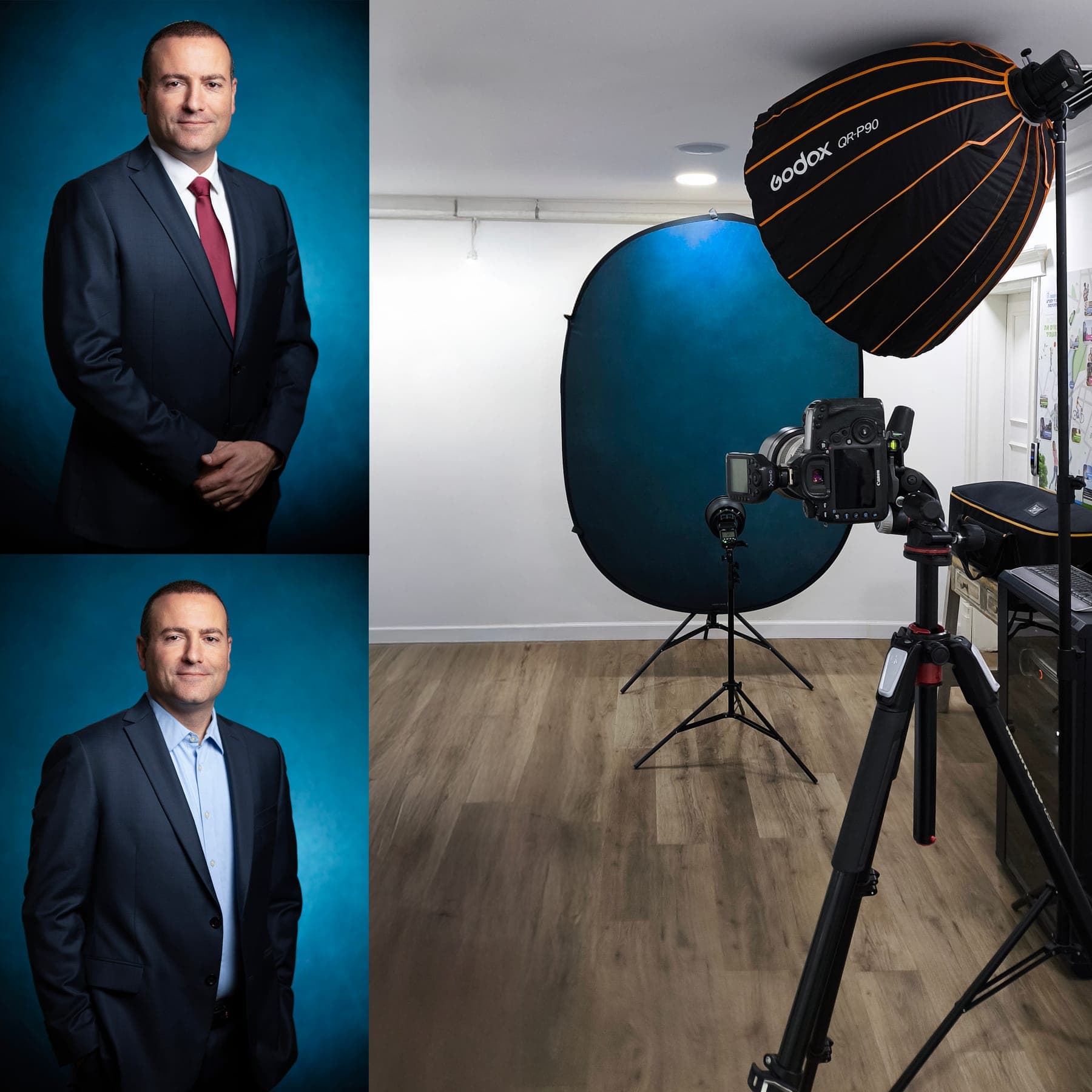
A dark backdrop, black or dark grey, is the one I work with most, because of the method of selective light: light that does not illuminate the whole frame but chooses the face and leaves the rest in shadow. On a dark backdrop that choice is clear. The background sinks, the face rises, and depth appears.
Suits: LinkedIn and WhatsApp, whose interface is light so the dark picture stands out in it; fields that ask for seriousness and authority, lawyers, executives, public figures; articles and the press.
Examples: the headshot of Dafna Liel in a white shirt on a dark blue-grey backdrop, and the campaign picture of Gideon Sa'ar in a blue suit on a dark blue backdrop. In both, the face is the only bright point.
A grey backdrop: the neutral that suits everyone
Mid grey is the safest backdrop. It does not compete with the face and does not swallow clothes, it works with a dark suit and with a light shirt, and it looks good on a light website and on a dark one alike. That is why it is almost always the choice for a team page: when everyone is on the same grey, the differences between the people are the real differences, not differences of background.
Suits: the company website and the team page, reports and presentations, anyone who is not sure.
Example: the official headshot of Moshe Lion, head and shoulders on neutral grey. That is the set that works for a whole management page.
A white or light backdrop: clean and open
A white or light backdrop gives a clean, modern, approachable look. It suits educators, therapists, start-ups and anyone whose message is openness. It has two drawbacks: on LinkedIn and WhatsApp the interface itself is light, and a picture on a white backdrop is swallowed in it; and in fields such as law it can feel sterile.
Suits: a light website, a uniform team catalogue, fields that ask for approachability.
Example: the headshot of Rabbi Menachem Bombach on light grey, a grey suit and a patterned tie. The light backdrop opens the picture, and the tie gives it life.
The office itself: when the place is part of the story
Sometimes the right background is not a backdrop. A bureau with flags, a law firm's library, a laboratory. In those cases the place says something about the person, and removing it would erase that. The condition: the place has to be tidy, the light built as in the studio, and the background blurred enough not to compete with the face. The portrait lenses do that.
Suits: public figures and heads of local authorities, profiles in articles, personal branding.
Example: the headshot of Aliza Bloch in her office, at the desk, with the flags behind. Taken with the mobile studio, without a studio backdrop.
The backdrop comes with the mobile studio
All four backgrounds are available when the shoot is at your place too. The mobile studio brings neutral backdrops, grey, black, light or dark, on a stand, and the backdrop is placed behind the subject within minutes. A yellow wall, family photos on the shelf and a window overlooking the car park do not enter the picture. And whoever wants the office itself as the background gets it, tidy and blurred as it should be.
Background and clothes: three pairings that recur
A dark suit on a dark backdrop. Works, on one condition: a line of light on the shoulder that separates the garment from the background. Without that line the body is swallowed and the head floats. In the picture of Shlomo Filber you see that line exactly.
A white shirt on a light backdrop. Does not work. The shirt disappears and the face is left alone. A white shirt wants a dark or a grey backdrop, and there it does its best work: contrast that leads the eye to the face.
One strong colour. A coloured tie, a teal blazer, red glasses. One coloured detail on a neutral backdrop gives the picture life without competing with the face. Two already compete.
A backdrop for a team: the decision that holds for years
On a team page the backdrop is not a matter of taste but of consistency. It is chosen once, usually neutral grey, and recorded together with the other parameters of the set: the position of the lights, the distance from the camera, the crop. Every employee who joins later is photographed on the same backdrop under the same conditions, in a catch-up session, and their picture enters the page with no sign that it was taken on another date. A company that changes backdrop halfway gets a page that looks like two periods. How to organize that on the company's side, in how to organize an employee headshot day.
Background and black and white
Every client also receives a black-and-white version. In black and white the background loses its colour and remains only as brightness, so the difference between dark grey and dark blue disappears, and the difference between dark and light remains. A picture taken on a dark backdrop comes out dramatic in black and white, like the picture of Aaron Ciechanover; a picture on grey comes out soft. That is one more reason to choose the background by the use and not by a favourite colour.
How to choose
In the scoping call I ask two questions: where is the picture going, and what does it need to convey. LinkedIn and authority, a dark backdrop. A team page, grey. A light website and approachability, light. A place that tells a story, the office. When in doubt we shoot on two, and it adds no time. Everything else, the clothes, the lighting and the crop, follows from that decision.
In summary
A headshot background is a choice by use: dark to isolate the face and for seriousness, grey for consistency and for every purpose, light for openness, and the office when it is part of the story. The backdrop comes with the studio, permanent or mobile, and the choice is settled in a short conversation before the shoot. To book: WhatsApp 054-2000-300.

Frequently asked questions
- Which background suits a headshot best?
- There is no single right background. A neutral grey suits almost every purpose and team consistency, a dark backdrop sets off the face and conveys seriousness, a white backdrop gives a clean, open look, and the office itself suits when the place is part of the story. The choice is made in the scoping call according to the use.
- A white background for a headshot: when yes and when not?
- Yes when you want a clean, modern look, for a light website or a team catalogue on a uniform backdrop. Less when the picture is meant for LinkedIn and WhatsApp, whose interface is light and in which a white backdrop is swallowed, and less for fields in which white feels sterile.
- What does the background do to the face?
- A dark backdrop isolates the face and makes it the bright point in the picture, so it flatters most skin tones. A light backdrop opens the picture but competes with the face for brightness, so it needs stronger light on the face. A grey backdrop sits in between: neutral, neither competing nor swallowing.
- Does the backdrop come along for a shoot at the office?
- Yes. The mobile studio brings neutral backdrops, grey, black, light or dark, on a stand. The backdrop is placed behind the subject, and the most ordinary corner of the office looks like a studio.
- How do you keep a consistent background across a large team?
- You choose one backdrop in the scoping call, set it up once, and do not move it or the light for the whole day. An employee who joins after the photo day is photographed on the same backdrop and at the same distance, so their picture fits into the team page.

Written by
Sharon Gabay
Portrait, headshot & fine-art photographer · author of six photography books
More about Sharon Gabay →Related articles

Ready for a photo that works for you?
Tell me what you need and we'll find the right format together. We can shoot in my professional studio, or I'll come to you with a full mobile studio — anywhere in Israel.