
Lighting in Headshot Photography — Why the Same Face Looks Completely Different
Lighting in headshot photography: Rembrandt lighting, why a window is not a studio, how soft light builds trust, and what wrong light does to a face.
Here is an experiment I sometimes run in the studio, especially with someone who arrives certain that "he is not photogenic": two photographs of the same person, in the same chair, in the same clothes, a minute apart. In one he looks tired, heavy, with shadows under the eyes. In the other — sharp, present, authoritative.
Nothing changed except one thing: where the light came from.
That is the whole secret of headshot photography, and it is also what most people do not know when they judge themselves by a selfie: your face is a constant. The light is the decision.
What light does to a face — the physics in brief
A face is topography: forehead, nose, cheekbones, chin. Light creates shadow on it — and the shadow is what shapes what we see.
Light from above (typical office lighting) pours shadow into the eye sockets — that is how the tired look on the employee badge is born.
Light straight from the front (a phone flash) flattens everything — the face loses depth and looks wider.
Properly built light — a large, soft source, at a calculated angle, with gentle fill from the other side — gives the face depth without harshness. That is the difference between a record and a portrait.
Rembrandt lighting — why a 400-year-old technique still works
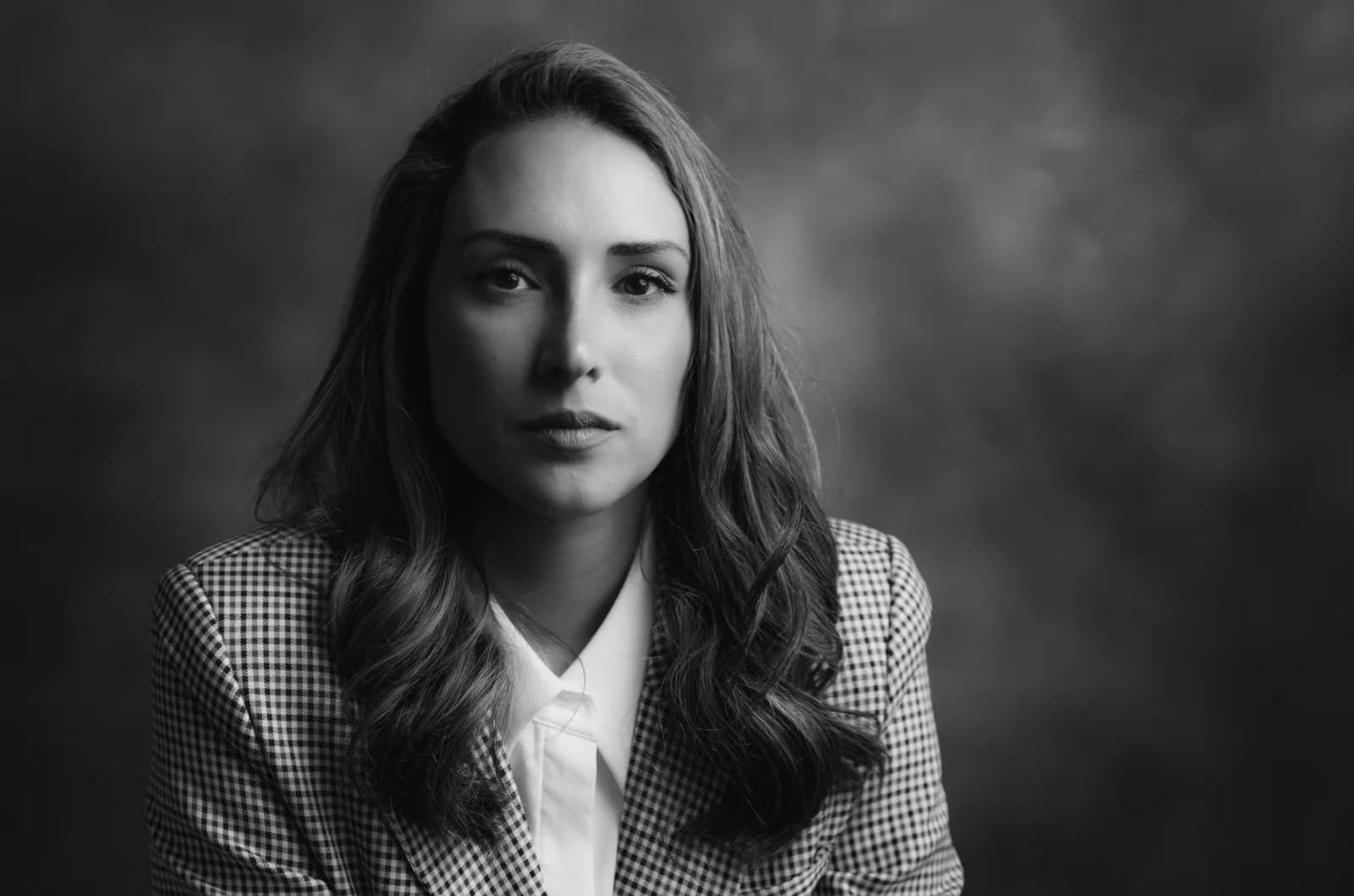
The Dutch painter Rembrandt lit the faces of his subjects from an angle of about 45 degrees above and to the side — which creates a small triangle of light on the shadowed cheek. That technique lives on to this day in every serious studio, because it does two things at once: it adds depth and three-dimensionality to the face, and it keeps a restrained drama that suits a business photo as well.
In headshot photography I use softened versions of it: enough direction to sculpt the face, soft enough for the result to stay flattering. I wrote a whole article on the relationship between light and shadow in a portrait, and also on selective light — the technique that emphasises exactly what is needed.
Why a beautiful window is still not a studio
"We have a huge window at the office, can we shoot there?" — an excellent question, and the answer explains why a studio exists.
Window light really can be beautiful. But it is not under control: at ten in the morning it is different from noon, on a cloudy day it is different from a clear one, and it always comes from one direction. What works for one subject will not work for the next.
In a studio — fixed or mobile — the light is built: a key source, fill, separation from the background. And most important for businesses: it is reproducible. A team of thirty employees photographed over a whole day comes out completely consistent, and the employee who joins in six months will get exactly the same light. The mobile studio brings that capability to any office in the country.
Lighting is half the retouching
A tip that saves money and time: what is solved with light needs no Photoshop. Shine on the forehead, uneven skin tone, shadows under the eyes, glasses that glare — all of them are solved with lighting before the shutter is pressed, not in retouching afterwards. That way the retouching stays what it should be: a final refinement, not rescue surgery. The result looks natural — because it really is natural.
In summary
When a photo "doesn't appeal to you", in most cases you are not looking at your face — you are looking at wrong lighting. Professional headshot photography is first of all light engineering: building around your face the conditions in which it looks the way it really is. The packages and prices are on the services page.
Frequently asked questions
- What is Rembrandt lighting in headshot photography?
- A classic lighting pattern named after the Dutch painter: a key light at an angle of about 45 degrees that creates a small triangle of light on the shadowed cheek. It adds depth and character to the face, which is why it is a central working tool in modern headshot photography as well.
- What is the difference between soft and hard light in photographing a face?
- Soft light comes from a large, close source (a large softbox) and wraps the face in gentle transitions — flattering to most people. Hard light from a small source creates sharp shadows that emphasise every line and texture. In a business headshot the basis is soft light, with touches of direction to create depth.
- Why is it not enough to be photographed by a window in natural light?
- Window light can be beautiful, but it is not under control: it changes with the hour and the cloud cover, comes from one direction only, and cannot be reproduced at the next shoot. In a studio the very same light is built — for every subject, at any hour, including a team shoot that needs to look consistent.
- How does the right lighting help someone who does not like being photographed?
- Wrong lighting produces dark circles under the eyes, shine on the forehead and hard shadows — and then people are convinced that "they are not photogenic". Properly built lighting does the opposite: it shows the face as it looks in reality, on a good day.
- Can lighting replace retouching?
- Mostly — yes. What is solved with light needs no correction on the computer: the right lighting removes shine, softens fine lines and balances skin tone before the shutter is pressed. Retouching remains for refinement, not rescue.

Written by
Sharon Gabay
Portrait, headshot & fine-art photographer · author of six photography books
More about Sharon Gabay →Related articles
Ready for a photo that works for you?
Tell me what you need and we'll find the right format together. We can shoot in my professional studio, or I'll come to you with a full mobile studio — anywhere in Israel.