Election campaign photography · dozens of public officials
Election Campaign Photography
Campaign photography for Knesset candidates, mayoral races and primaries. One session that produces the full campaign image bank — billboards, posters, social media and press — in the studio or with a mobile studio, anywhere in Israel.
What is election campaign photography?
Election campaign photography is the professional photography of candidates and public figures for an election — images for billboards, posters, social media and the press. Unlike a standard headshot, it is tailored to the political message, the voter audience and every campaign platform, and is delivered nationwide with a mobile studio that comes to the campaign HQ.
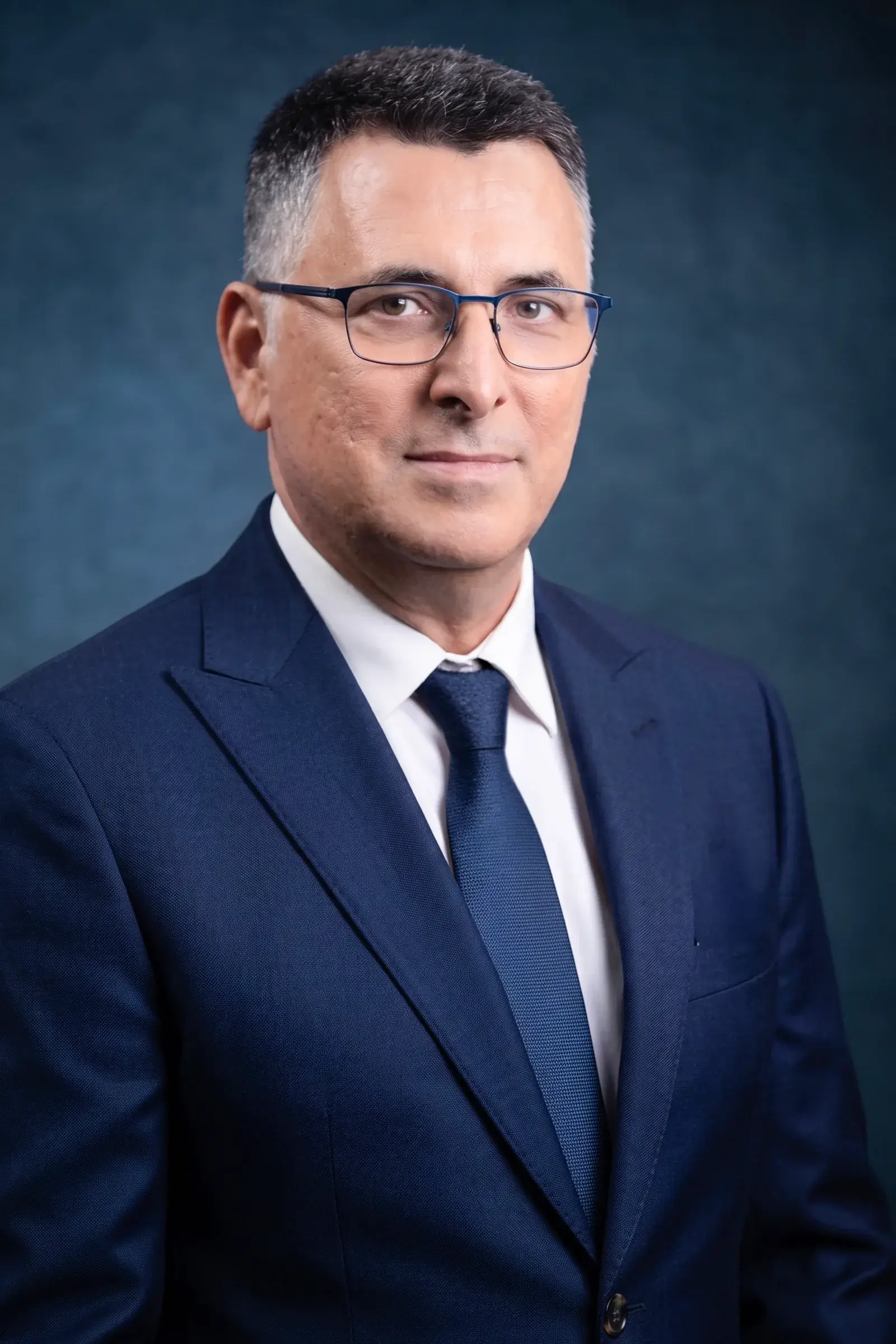
The photos a campaign needs — from the billboard to social media
During an election season in Israel, your photo works for you 24 hours a day. It hangs on billboards over the Ayalon highway, sits atop your Facebook page, gets screenshotted thousands of times in Stories, and appears in the news headlines. All of that — before a single voter has heard one sentence from you.
It's no accident that Knesset candidates, mayors, ministers and primary contenders invest in professional campaign photography. It isn't a luxury. It's a core budget line in every serious campaign in Israel in 2026.
My name is Sharon Gabay, and for 15 years I've been photographing political campaigns in Israel. I photograph politicians, Knesset candidates, mayors, members of Knesset, sitting ministers and contenders in the primaries of the major parties. My mobile studio comes to you — to campaign headquarters, to your office, to the bureau — and photographs your whole team in a single, concentrated day.
What exactly is "campaign photography"?
Campaign photography is not a regular headshot. It's a product with entirely different technical, emotional and strategic requirements.
A regular headshot is meant for a personal website, a LinkedIn profile, a magazine feature. It's designed to depict a professional in a static state.
A campaign photo is an active political-marketing tool. It's built to work on a 6-by-3-meter billboard. To appear in viral posts. To be sent in tens of thousands of WhatsApp messages. To run as a full page in a national newspaper. To be printed on flags, shirts, stickers and flyers.
And each of those uses has different technical demands — which have to be calculated during the shoot, not in retouching.
What research shows about how a photo affects voters
Research from Princeton University, published in leading scientific journals, has shown that people judge a candidate's trustworthiness and competence within a one-second exposure to a face. That judgment is durable — even when voters receive more information about the candidate, the first impression from the photo keeps influencing the vote.
The research also showed that competence ratings based on facial features correctly predicted the outcome of 68.8% of the 2004 US Senate races — even when participants did not recognise the candidates. This isn't about good looks. It's about facial language, body language, lighting and placement.
That's why every serious campaign in Israel begins with professional photography. Because without an organised image bank, a campaign starts at a gap.
Source: Todorov et al., Science, 2005.
What the Israeli voter is looking for in your photo
The voter — whether a Likud primary member, a member of the Democrats party, or a resident looking for a new mayor — asks themselves two questions in a split second:
The first question: "Can I trust this person?"
The second question: "Can they represent me?"
Both questions are answered instantly, based on the facial expression, the gaze, the body language, the clothing and the lighting. My job in campaign photography is to give your photo both answers — without the voter ever realizing they were asked.
Three types of candidate — three different photos
Over the years I've learned that there's no single campaign photo that fits everyone. The visual message has to match the role you're running for, your target audience and the campaign's central political message.
A Knesset candidate in a primary
This is the most complex type to photograph. The candidate has to convey two things at once: belonging to the party base on one hand, and leadership ability on the other.
A photo that's too dramatic looks detached — as if you're already prime minister, not a candidate asking for the trust of party members. A photo that's too relaxed looks weak — as if you don't really believe in yourself.
The solution: confidence without arrogance, an approachable smile without a wink, a direct gaze without aggression. Classic lighting — not too dramatic, not flat. A clean background. And one more small detail: in a primary, it's worth having a photo that differs from your previous one — to show progress, not stagnation.
A candidate for mayor or local authority
The local voter is looking for one thing: a neighbor. Someone who knows their neighborhood, who they could grab a coffee with, who understands the problems on their street.
So in a municipal campaign I tend to recommend warmer lighting, a background that conveys a sense of place (it doesn't have to be a cityscape — sometimes a warm background tone is enough), and an open, natural smile. Sometimes I shoot on location with a familiar neighborhood, an urban street or a public building in the background.
A senior MK, minister or high-ranking official
Here the story changes. You don't need to look like "one of us" — you need to look like a leader. That means classic lighting with a soft shadow on the cheek (the Rembrandt technique), a deep, dark background, a tailored outfit, and a direct, serious gaze — but not a frozen one.
This is the kind of photo that appears on giant billboards at the entrance to Tel Aviv, on full-page newspaper ads, and on a weekend magazine cover. It has to look excellent at 6 meters tall and just as good as a thumbnail in WhatsApp.
Election season 2026: why now is the time to shoot
Israel is heading into an intense election season. Primaries in the major parties are around the corner. Local elections. General elections in the air. Anyone with a political ambition has to start preparing now.
The reason is practical: a campaign photographer's calendar fills up at record speed during election season. In the peak months — three months before election day — there's no room, no time and no ability to shoot under pressure. A campaign photo taken on the Friday before an election Saturday, with no preparation, no makeup and no organized wardrobe choice, will be a bad photo.
The shoot itself takes 2–3 hours. But the preparation beforehand, the retouching afterward, and the technical adaptations for every platform (billboard, Facebook, Instagram, WhatsApp) take at least two weeks. If you start less than a month before the campaign, you're already late.
My recommendation to every candidate: book a shoot the moment the internal campaign opens. Before the official announcement of candidacy. Before the advisors, strategists and PR people enter the picture. Because then you have time to shoot calmly, to consult, to think, and sometimes even to reshoot if something didn't work.
Lighting, background and wardrobe — the three pillars of a campaign photo that works in every format
Lighting
For politicians I recommend classic lighting with a soft shadow on the cheek — a technique called Rembrandt lighting. It creates depth, volume and a sense of professional maturity. Your gaze looks deeper. The face looks complete, not flat.
What not to do: completely flat lighting (conveys disinterest), overly dramatic lighting (conveys threat), extreme side lighting (creates a "villain" effect). These are all common mistakes in campaign photos made by photographers who don't specialize in the field.
Background
The classic background for a political campaign is deep gray or deep black. These backgrounds focus the eye on the candidate's face and expression. They look excellent on billboards and create contrast that emphasizes the face.
A white background? Not recommended for a campaign. It looks sterile, too studio, detached from the people. A green background with trees? Trendy for a moment, but distracting. An "urban" background with buildings? It can work for a candidate who wants to convey an urban role, but it weakens the face.
Sometimes the right solution is a neutral background in a complementary color — deep blue-gray, walnut brown, or a tone chosen specifically to match the party's colors.
Wardrobe
A dark suit, a buttoned white shirt, a tie — or without one. The choice depends on the target audience and the message.
A candidate representing a traditional, conservative audience — suit and tie. A candidate from a "protest movement" or a young MK — a buttoned white shirt with rolled-up sleeves, no tie. Women candidates — a dark blazer, a minimalist finish, no distractions.
I always ask candidates to come with 2–3 different sets. We choose together based on the message, the lighting, and how each outfit "falls" in the photo. A set that looks great in the mirror doesn't necessarily look great on camera.
Body language in campaign photography: what the voter reads without knowing
A campaign photo is 30% face, 30% lighting and 40% body language. And even though it looks like "you're just standing there," your body language sends a clear message to the voter.
Gaze
A direct gaze into the camera — not aggressive, not evasive. It conveys confidence, integrity and openness. A politician looking off to the side in a photo seems like they're hiding something, or daydreaming. Both are bad for a campaign.
Sometimes, for "in action" photos (a conversation, a speech, listening), the gaze is toward someone off to the side. But for the main campaign photo — the poster, the billboard, the cover — always a direct gaze.
Posture
A straight back. Open shoulders. Head held high. This conveys confidence, presence and leadership. Politicians under pressure — and a campaign is enormous pressure — unconsciously tend to hunch their shoulders, lower their head slightly, or close in on themselves. The voter reads all of these instantly as weakness or insecurity.
My job in the shoot is to recognize this language and help you open up. It's not "stand nicely" — it's real work of releasing the body and the breath.
Expression
A slight smile — not frozen, not too wide, not forced. An expression that says: "I'm here. I'm listening. I know what I'm doing. You can rely on me."
Too wide a smile = too optimistic = not serious. A completely neutral expression = cold = alienating. The right slight smile is exactly the balance. And getting it on camera is an art. I don't ask the candidate to "smile." I create a situation in which the smile arrives on its own, out of conversation, out of a genuine moment.
A campaign photo package: what you get in a single session
A candidate needs far more than one photo. The modern digital campaign devours visual content at a frantic pace, and you need an image bank that will last entire months of campaigning.
Here's what I shoot in a standard campaign session:
A main campaign photo — head and shoulders, clean background, direct gaze. This is the photo that will appear on the billboards, on the home page of the campaign website, and on your flagship campaign posters. Shot in both vertical and horizontal formats.
Half-body photos — for social media, marketing posts, flyers. Here we can play with different angles, different smiles, different gazes — to build a rich bank.
All of this — in a single concentrated session of 2 to 3 hours, a mobile studio that comes to you, providing a complete package that will carry you through the entire campaign.
Working with a campaign team: how the strategist, advisor and designer fit in
Anyone who knows the world of campaigns knows the campaign photographer isn't a lone link. He's part of a system.
Before the shoot I meet (or at least talk) with the campaign strategist, to understand the central message. Security? Economy? Society? Change? Conservatism? Each of these translates differently into lighting, background, wardrobe and expression.
Before the shoot I get the "visual brief" from the graphic designer — how the photo will look on the billboard. Where will the slogan go? Left? Right? Bottom? This directly affects the composition — I need to leave "air" on the right side of the frame so the designer can place text there without cropping you.
Personal experience with politicians in Israel
Over the past 15 years I've photographed dozens of politicians and public figures — mayors, members of Knesset, ministers, election candidates, and contenders in the primaries of Likud, the Democrats party and others.
I've photographed coalition chairman Ofir Katz, Foreign Minister Gideon Sa'ar, the mayor of Ashdod, the mayor of Be'er Ya'akov, the mayor of Beit Shemesh, MK Avichai Boaron, MK Amit Halevi, MK Sharren Haskel, MK Walid Alhawashla, MK Iman Khatib-Yassin, Arad mayor Yair Maayan, Jerusalem mayor Moshe Lion, Nobel laureates Prof. Hershko and Prof. Ciechanover, and many more candidates in local and national campaigns.
The most important thing I've learned about photographing politicians: most of them don't like being photographed. They're busy. Stressed. Worn out from the campaign. And sometimes they feel the shoot is just another item on the to-do list. My job is to make the experience easy, efficient and enjoyable — to finish fast, deliver an excellent result, and let them get back to the real work of the campaign.
Nationwide — a mobile studio that comes to you
I don't ask you to come to a studio. I come to you.
My mobile studio includes all the professional equipment required — lighting, backdrops, cameras, lenses, control monitors. I set up a full studio within an hour, anywhere in the country — at your campaign headquarters in Tel Aviv, at the mayor's bureau in Haifa, at a regional-council office in the Negev, or at a private home in Jerusalem.
It saves you time, lets you photograph the whole team in one place, and maintains full discretion.
Frequently asked questions about campaign photography
How much does campaign photography cost?
The price depends on the scope: a single photo, a full campaign package, or a complex shoot day for the entire campaign team. For an accurate quote, you can contact me on WhatsApp at 054-2000-300 and describe the campaign, the role you're running for, and the scope required.
How long before the election should you shoot?
At least a month before the public campaign begins, and preferably three months. The reason: quality retouching, adaptations for the various platforms, and a backup in case a reshoot is needed — all of these take time. A last-minute shoot dramatically lowers the quality of the final result.
Can the entire campaign team be photographed in one day?
Yes, and it's highly recommended. I come with the mobile studio to the campaign headquarters and, in a concentrated day, photograph the main candidate, their deputies, the party spokespeople, the campaign managers and key people — all in a consistent style, with identical lighting and the campaign's official look.
What's the difference between primary photography and general-election photography?
In a primary, the audience is party members — a defined ideological base looking for belonging and commitment to the party's values. In a general election the audience is broad, diverse and includes undecided voters. The visual message differs in each case — in a primary you emphasize belonging; in a general election you emphasize leadership and universal values.
Does a candidate need a makeup artist for a campaign shoot?
For men — not mandatory. For women — mandatory. Professional makeup ensures the photo looks natural and flattering under studio lighting. We recommend a professional makeup artist, and can recommend one in advance.
Do the image rights cover all media?
Yes. In a campaign photo package, the usage rights cover all platforms — billboards, the internet, social media, print, flyers, shirts and stickers. No usage limits, no per-platform surcharges.
Can you shoot at a specific location instead of in a studio?
Absolutely. We can shoot at the bureau, the office, the boardroom, on the street, in front of a public building, or at any location that fits the campaign message. The mobile studio is built to work in field conditions too.
Can you shoot urgently before an election?
It's possible, subject to calendar availability. It's important to understand: shooting under the pressure of a few days before election day doesn't allow for quality retouching, adaptations for all the platforms, or a reshoot in case something didn't work. The clear recommendation is to book a shoot the moment you start thinking about running — not days before.
Let's talk about your campaign
If you're running for office, planning a primary, or preparing for a municipal or national campaign — I'd be glad to talk with you.
Sharon Gabay – Photographer
Proven experience
Public figures already photographed
Among those photographed — members of Knesset, ministers, mayors and council heads. Each name links to their Wikipedia entry and to the portfolio.