
The Boy Who Asked for the Kotel
A family flew from South America so their son could kiss the stones of the Western Wall — then two birds passed. The story behind an anchor image.
Some photographs you chase for years, and some find you. This one found me, at the plaza of the Western Wall.
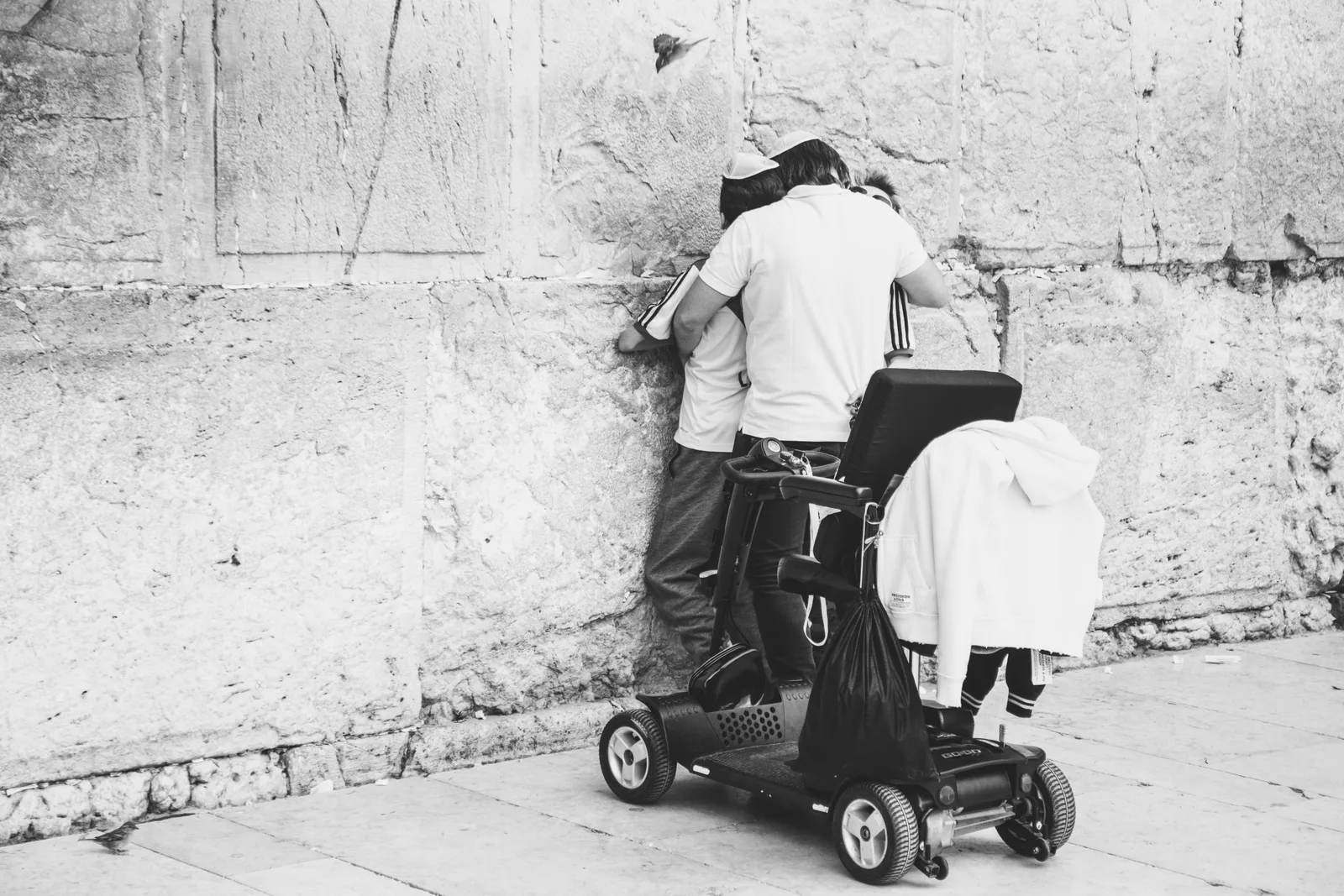 Western Wall photograph from the book "Jerusalemites." Photo: Sharon Gabay
I was standing there as always — not facing the stones, but facing the people. And I saw a family that had come from South America, from the other side of the world, for a single moment.
One of the sons is a boy who is paralyzed. When he reached bar mitzvah age, they asked him what he wanted to receive. He didn't ask for a gift or a party. He asked to reach the Kotel. And they came.
The Moment
In the photograph you can see the father lifting his son from the mobility scooter — you can see it empty, right beneath him — and pressing him against the stone, so the boy could kiss the Wall himself. With his other arm he embraces the second son. Three heads bowed together toward the giant stones.
I asked nothing of them. I didn't stage it and I didn't move anyone — street photography doesn't work that way. You just stand, watch, and wait for the moment that won't return.
The Two Birds
And then came the thing you can't plan. Two birds passed above the boy. The first in the lower-left corner of the frame, the second frozen in the air — right above his head.
The birds passing made the boy lift his head. In that fraction of a second — the father pressing him to the stone, the arm embracing, the bird hovering above — I pressed the shutter.
This is an "anchor image": a one-time moment that can't be staged and can't be repeated. Either you're there, or you've missed it forever.
Why Black and White
I removed the color because it distracted. Without color, only what matters remains — the stone, the body, the embrace, the bird — and the soft Jerusalem light that wraps around it all.
Where the Photograph Lives
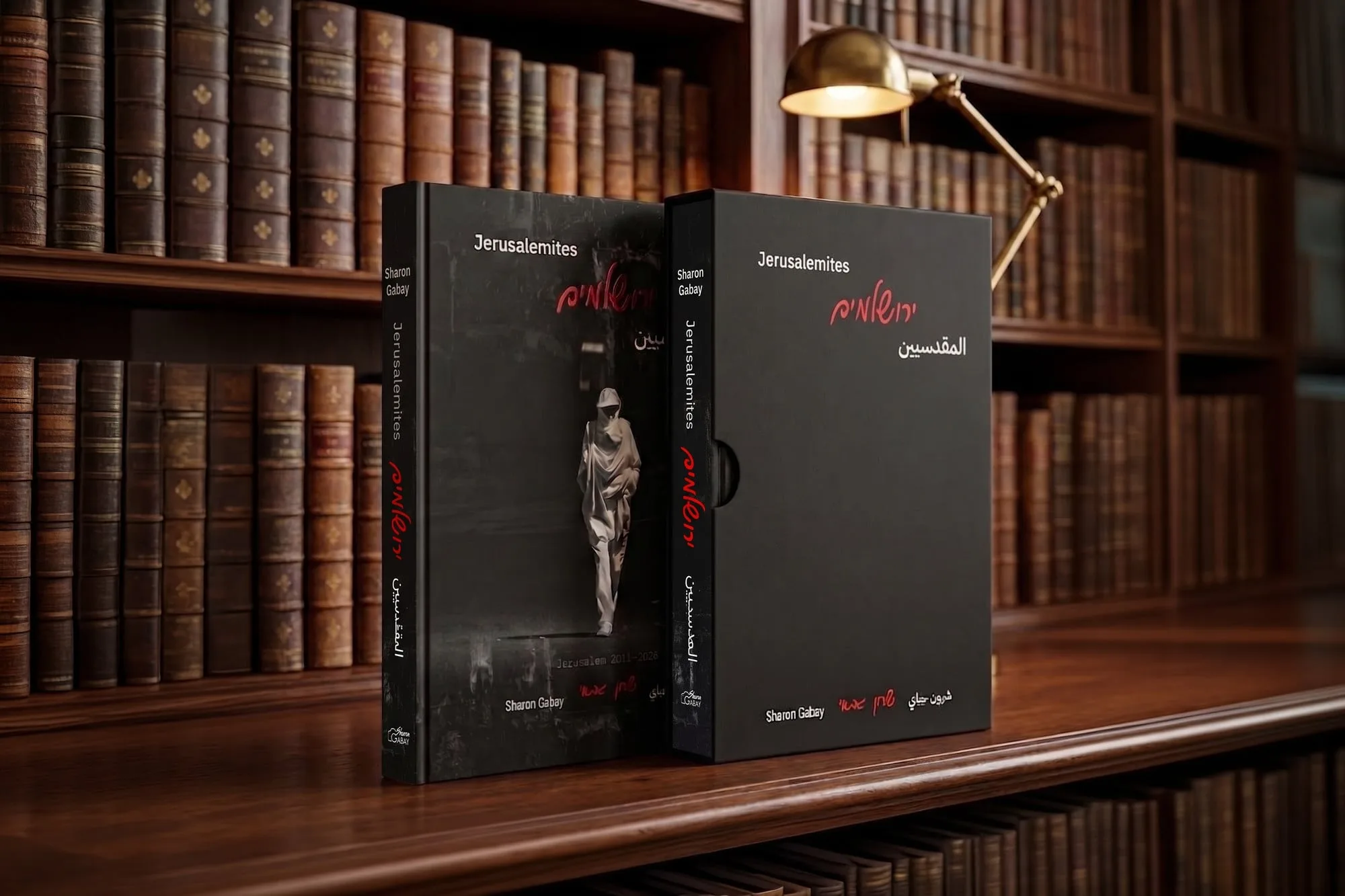
This moment entered the photography book Jerusalemites, a visual essay of 15 years photographing the city's streets, and it is one of the anchor images on which the entire book was built — the book many readers hand on as a Jerusalem gift. Because this is what Jerusalem knows how to do: take a stone thousands of years old, a boy from the other side of the world, and two birds — and join them into one unforgettable moment.
Technical: Behind the Lens
Shot on a Canon EOS 7D with a Canon EF-S 17-55mm f/2.8 lens, at a focal length of 49mm. I worked wide open (f/2.8) to isolate the family from the background stones and give the faces all the attention, at a shutter speed of 1/640 second — fast enough to freeze both birds in the air. ISO 100 and the soft Jerusalem afternoon daylight kept the stone clean and the tones full. The angle is that of true street photography: I stood behind and at street level, without staging or direction — just waiting for the moment.
Is there a photograph in the book that speaks to you? I'd love to hear from you on WhatsApp.
Want to hold the story in your hands?
Frequently asked questions
- What is the story behind the Western Wall photograph?
- A family from South America came to the Kotel at their son's request — a paralyzed boy who asked, as his bar mitzvah gift, to reach the Western Wall. In the photograph the father lifts him to kiss the stone and embraces his second son, while two birds pass above the boy at that very moment.
- Where was the photograph taken?
- At the Western Wall in the Old City of Jerusalem.
- Is the photograph in the book "Jerusalemites"?
- Yes. It is one of the anchor images on which the book was built — a visual essay of 15 years of street photography in Jerusalem.
- What is an "anchor image" in street photography?
- A one-time moment that can't be staged or repeated. In the book "Jerusalemites," the anchor images serve as pillars around which the entire narrative sequence is built.
- Who took the photograph?
- Sharon Gabay, a street and portrait photographer born and raised in Jerusalem, who has been documenting it for 15 years.
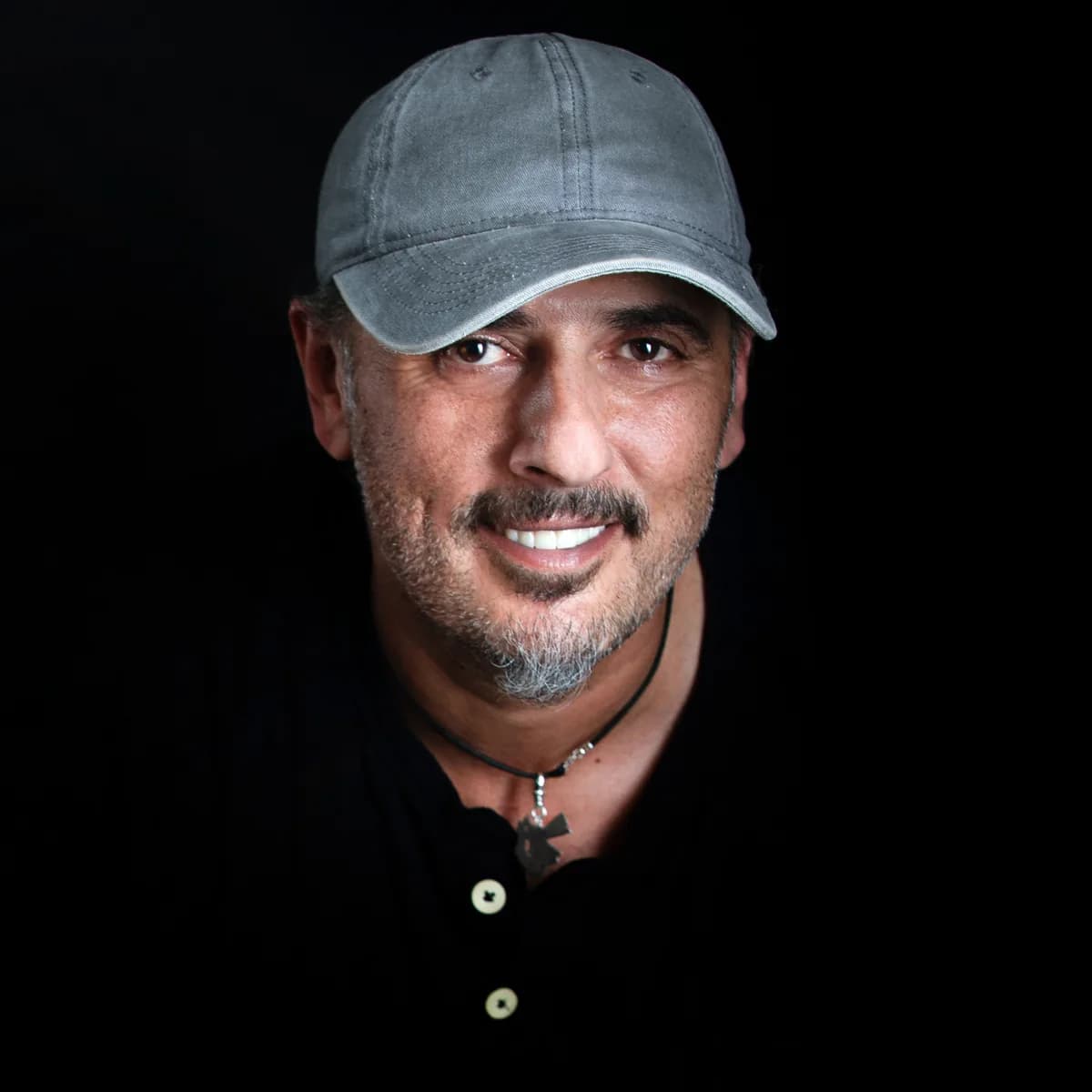
Written by
Sharon Gabay
Portrait, headshot & fine-art photographer · author of six photography books
More about Sharon Gabay →Related articles
Ready for a photo that works for you?
Tell me what you need and we'll find the right format together. We can shoot in my professional studio, or I'll come to you with a full mobile studio — anywhere in Israel.